
Disarming a Manipulative Co-parent: Part 1 - The Reboot
Frequently, parents reach out to me because they feel they and their children are being manipulated by their co-parent. Such behavior can leave you feeling vulnerable, exhausted, and defeated.
If your co-parent is hellbent on derailing your well-intended co-parenting efforts, what do you do? Is there anything you can do?
As a parent, you have rights. If you long to reclaim your parental rights and put an end to co-parenting manipulation, read on. You can redirect this damaging behavior back to a place of respect and protect your rights and the rights of your child.
Before we get into dealing with your co-parent though, let’s first deal with you.
First: You are Here and You Don’t Love it!
At this point, you’ve banked a mountain of negativity. Negativity fueled not by you, but by your co-parent. This isn’t your fault. But that doesn’t mean you have to accept it. I’m going to help you with that.
The first step is to release the emotions blocking rational thinking, firm communication, and good decision making.
Depending on the manipulation you’ve been subjected to, you may feel:
Angry that your co-parent is doing this to you and your child
Sad that your child is being misled to think less of you
Concerned that your child may turn against you
Afraid others will believe claims made against you
Exhausted by trying to get your co-parent to stop
Lost as to what to do about it
All of these feelings are valid. But they won’t help you productively address manipulative behavior with your co-parent. So before you have your next encounter with them, in person or virtually, let’s reboot your mindset.
Right now, it’s like you’re a computer program that’s stuck in a loop or has stopped responding altogether. You can’t move forward. Time to reboot!
The Co-parenting Mindset Reboot
These steps may sound idealistic or like a waste of time. Suspend judgment for a moment and come along with me.
To bring this exercise to life, grab a Post-it® pad or note pad. Make sure your notes are physical rather than virtual so you can place them somewhere easy to reference when communicating with your co-parent.
Step 1: Pinpoint a Positive Moment
Think back to a moment when you liked your co-parent. Maybe it was when you first met. Maybe it was brief. Or maybe you were deeply in love for years. It doesn’t matter. Identify one positive moment you shared with your co-parent.
Now, take your first Post-it® and draw an anchor on it.
Below the anchor, write the positive emotion or draw the emoji that represents how you felt in that moment (not how you feel now). This anchor helps return you to a more positive place when negative thoughts arise.
Example:
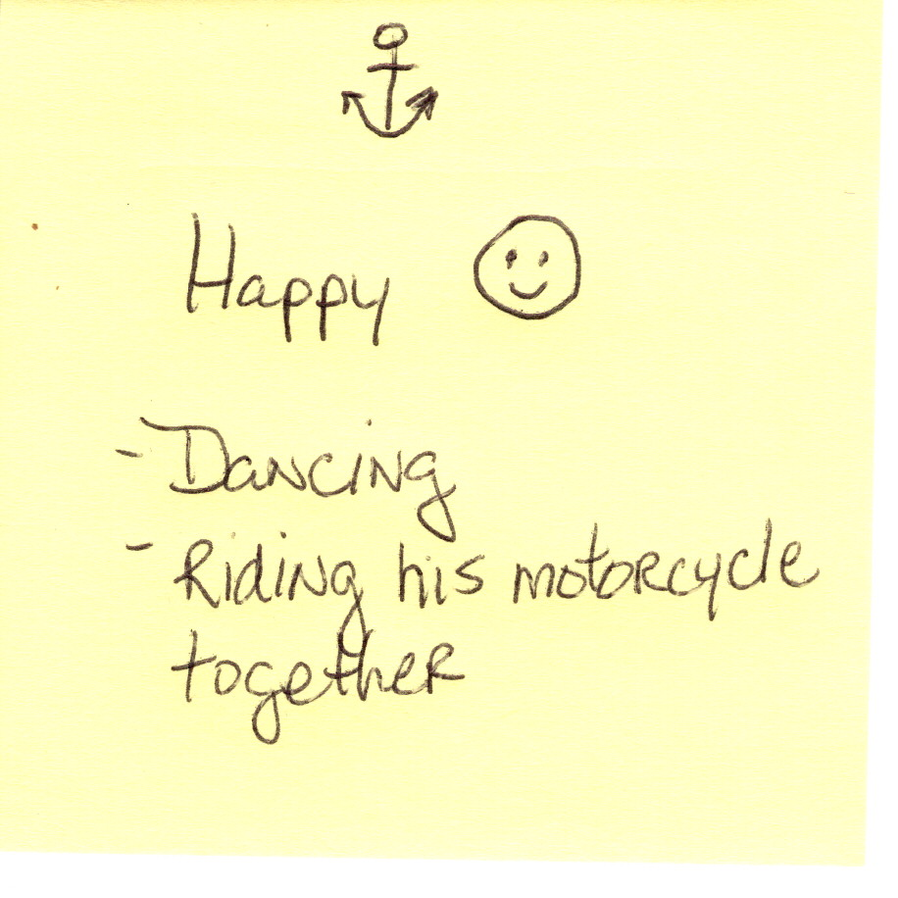
Add words to describe the setting of this moment such as “first date,” “picnic,” “dancing,” “movie,” etc. A single phrase that takes you back to that moment is enough to reinforce your anchor.
Step 2: Define Your Destination
You must know where you’re going before you can get there. So you need to define your destination and shift your focus away from where you are now. Ralph Waldo Emerson once said, “You become what you think about all day long.” If you want to feel respected or happy again, focus on that instead of the negativity you don’t want.
On your second Post-it®, write words that describe how you want to feel.
Example:

Step 3: Discard Your Before
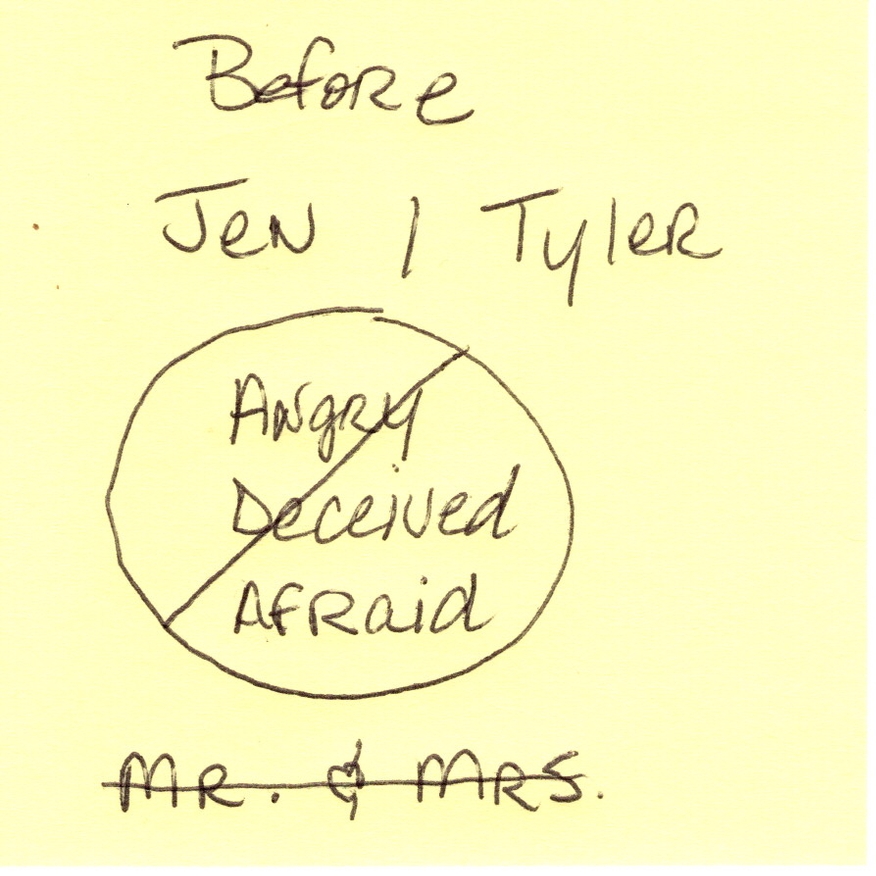
There’s the relationship you had with your co-parent before this moment and the new one you’re about to begin. On one Post-it®, write the words “Before” plus each parent’s first name. Below your names, write the 3 top negative emotions you feel right now toward your co-parent. Below that write how you and your partner identified yourselves as a couple, such as Mr. and Mrs., Life Partners, Passionate Encounter, etc.
Draw a circle with a line through it over your list of emotions. Then cross out how you used to identify yourselves as a couple. That version of you and your co-parent is over.
Example:
Step 4: Envision Your Now
Now that you’ve released the old version of your relationship, you’re free to create a new one.
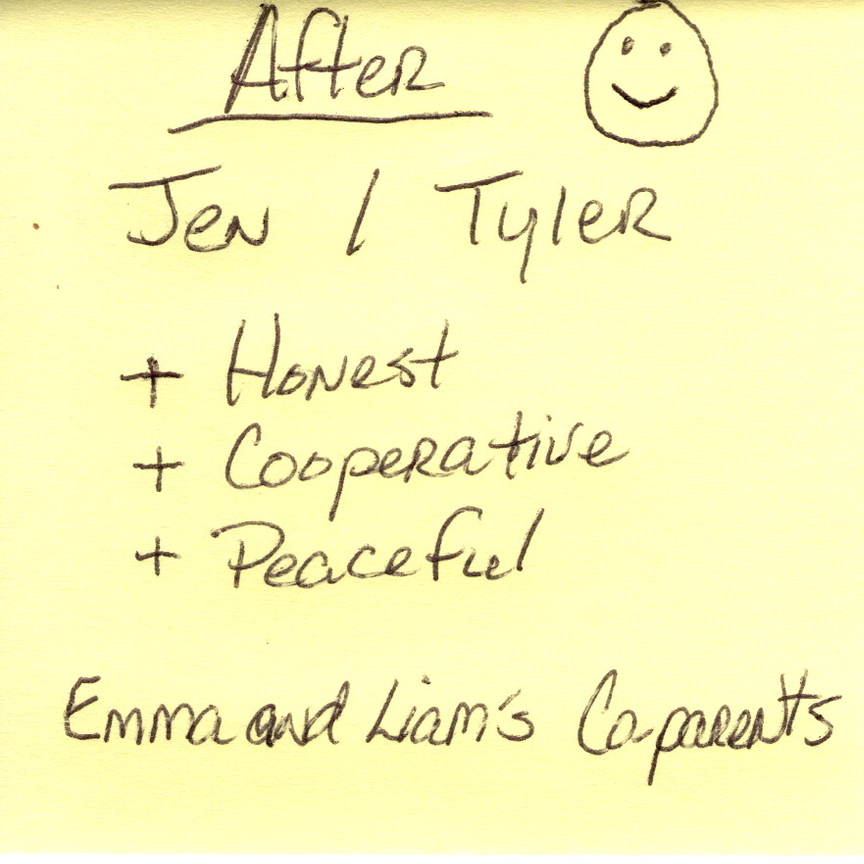
On another Post-it®, write “After” and both parent’s first name. Below that, list the top 3 characteristics that describe the co-parent relationship you want to have. Place a plus sign (+) in front of each. Below that, write your children’s name(s) plus the word “Co-parents.” Finally, draw a happy face in the top right corner.
Example:
Step 5: Live Your Co-parenting Vision
Place all 3 Post-it® notes near where you usually communicate with your co-parent. Make another for your car or purse to use for impromptu encounters.
When you feel a negative emotion toward your co-parent, glance at your “Before” note. Notice how everything’s crossed out. That’s because your previous relationship with your co-parent is over. Let it go!
Next, look at your anchor note. The anchor reminds you that you and your co-parent have potential.
Now look at your After note. The After brings you back to the present and the path you want to be on.
After rebooting, you’ve discarded the past and redirected your attention back to what you want your co-parenting relationship to be.
How might this look in practice?
This exercise may seem a little new-age-y, but let’s walk through a common scenario to see how it works in practice.
Remember, manipulation only works when you engage with it emotionally. The response below is an example of how to take back your authority and disarm manipulation.
Scenario: My co-parent is badmouthing me to my child
Unfortunately, many parents bad-mouth their co-parent to or around their child. If this happens to your child, your kneejerk reaction may be to defend yourself. Set the record straight and discredit your co-parent. Then, of course, you’ll want to call your co-parent out in a phone call, text, or email. But let’s pause for a minute and apply your rebooted mindset.
Think back to that Anchor moment. Feel the potential that moment represents for the two of you to be amicable going forward.
Reflect on your Before note—the emotions you have released and the intimate relationship that you have let go. This makes room for a new, better relationship to develop.
Review your After vision of the Co-parenting relationship you want to create.
Rather than defending yourself, discrediting your co-parent, or lashing out at them, do this instead…
Let your child finish telling you what they heard. Let them get it off their chest.
Ask your child how hearing those things made them feel so they can process their emotions. “How did that make you feel?” They may say they felt angry, uncomfortable, or confused. They may ask you if what they heard is true.
Apologize for them becoming involved. “I’m sorry you had to hear that.”
Explain that this is something between you and their other parent. “This is something between your father (mother) and me. Thank you for sharing it with me.” That should be the extent of your answer. If they press for more information, simply tell them that it is not something for them to be involved in and that you will handle it.
Decide if the disparaging remark is worth addressing with your co-parent. If it’s an insignificant comment like “your mother is always late,” it’s probably not worth bringing up. But if it something more damaging such as “your dad lies,” then you owe it to yourself and your child to address it.
If addressing it, wait until you’re calm. Then write a short note to your co-parent using your usual written method.
Matter-of-factly recount what your child said they were told as precisely as possible.
Remind your co-parent that you both agreed in your parenting agreement not to speak negatively about each other to or around your child.
Recommit to this agreement.
Ask your co-parent to do the same for you. Stop talking.
If they say they will, thank them and end the exchange.
If they say they didn’t say such things, tell them you’re glad to hear that and politely end the communication.
If they refuse to stop, tell them you’re sorry to hear that and reiterate that your parenting agreement forbids disparaging each other to your child, that you intend to stick to those terms, and would appreciate it if they would the do the same. Cordially end the communication.
In my next article, we’ll take on some other scenarios and walk through alternative responses that will help you put a stop to co-parenting manipulation.
Teresa Luse is a Co-parenting Coach and author of Combative to Collaborative: The Co-parenting Code. Learn more at TeresaLuse.com